As my students have become more competent with tools in the past few years (and cripes, does it feel weird to say years…) I’ve gotten the chance to think: what would be really cool to do next? What would be just flat out awesome?
This slideshow requires JavaScript.
Here’s my answer: wood & lino prints designed by the student, for the students work. My summer crew churned out about 30 different wood projects and many pieces deserved something special. In the third week, I took the plunge and bought $80 worth of tools. We spent the next few weeks cutting as many designs as we could and experimenting with the results.
Since I moved into my new digs in April, my shop has undergone a number of changes. I blogged about the move-in and of course I went and changed it immediately.
First, a couple bright spots. Not long after I unloaded everything I realized two very important things about home ownership. One, you can put holes in whichever wall you want, where ever you want, when you want. Two, it’s expensive. But not these lights. Remember to buy the bulbs and make sure you wire’m up according to fire code. I’m a midnight rider now.
My new bench looks a bit beaten in today, but it works great for three months of use. I made some terrible looking mortise-and-tenon joints at each leg, but 3/4″ pegs have kept it tight and square. The top is very light – only one sheet of 3/4″ oak ply – so I used 1″ pine strips as reinforcement. My cheap vise completes the look. I never really meant to build this bench. I mean to build a Roubo handtool bench before next summer. I mean to build my wife a Craftsmen-style bench. I mean to do a lot of things. Which means I’ll have this bench for the next ten years…
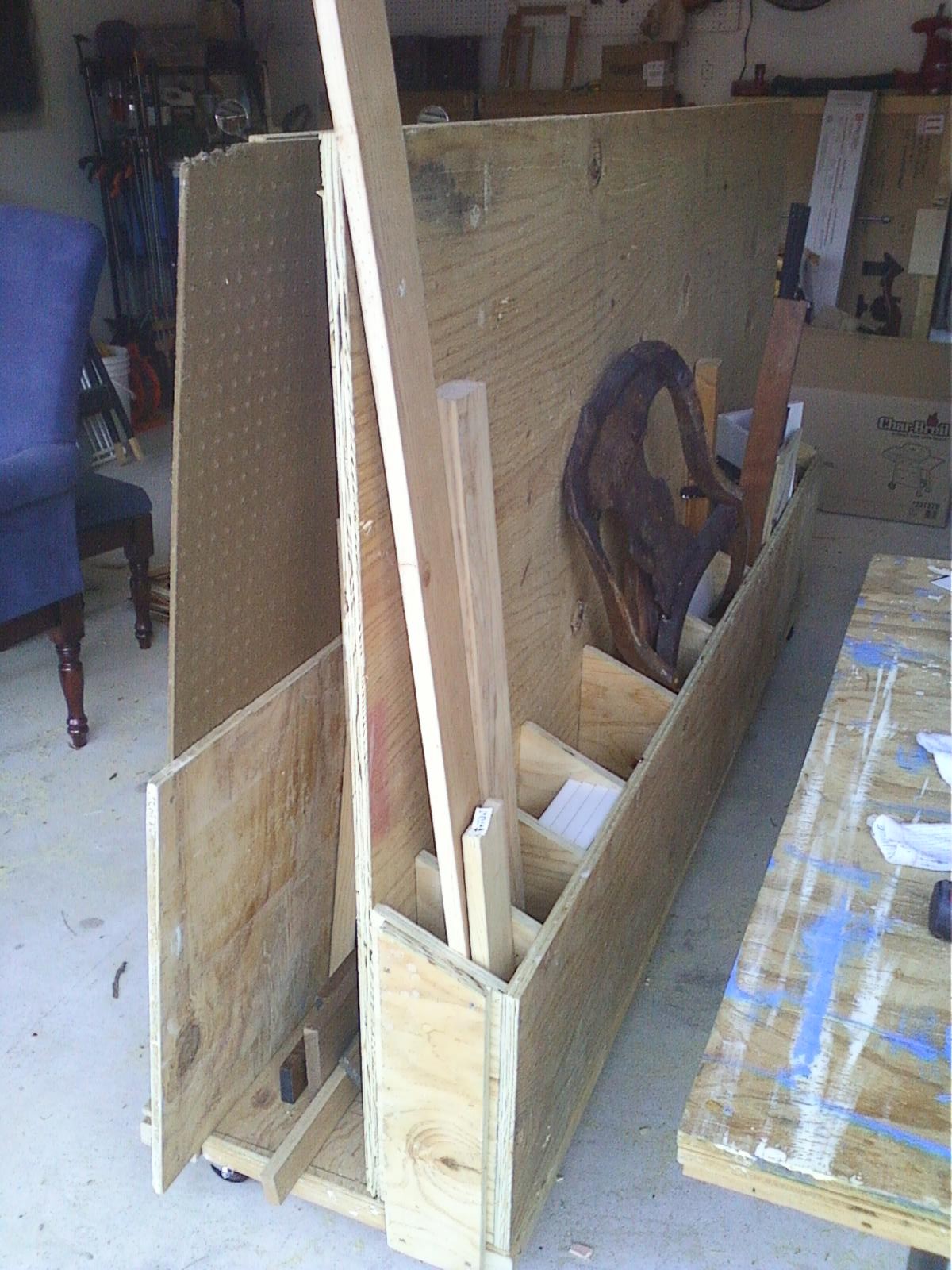
Last, but most importantly, new storage for lumber. I don’t make a lot of things (at least compared to retired guys and professionals) and what I do make tends to be salvaged lumber. I needed a small place to store lumber for two or three months worth of projects at a time. Something mobile, something easily organized, something limited. I’ve always admired the one at work, so I built my own. You can find plans for a similar cart here.
Make it safe & keep the rubber side down this weekend.
Here’s a few shots of a project build I did a few months ago. The challenge was to build a recycling container from completely recycled materials. I picked up some nice crepe myrtle branches and immediately saw a V shaped stand with a small basket to collect recyclable goods.
To bad we never did finish it. We got all the way to the crossbeam. Spring break came with all the lassitude of a wilted Texas flower in August. We never stood a chance.
This slideshow requires JavaScript.
Eventually, I snookered a student into repainting an old cabinet door into a chalkboard sign. Then I parked that sucker in front of the toolshed. I used crepe myrtle cut-offs, a some 2x12s, some brown paint, plywood and a few pulled screws.
Make it safe & keep the rubberside down this weekend.
Students with autism, people with neurological disorders and people with two eyes and ears and a brain often need a place to talk. For my students with autism, the act of conversation can be harrowing, heartwrenching and terrifying. On a good day. My students often must master sitting in one place, labeling the world with words and comprehending the speech of others. Once this is done, maybe they can open themselves to the vulnerability, the hurt, the anguish and the ecstasy of a conversation. I’m known as a loquaciousness guy, but make no bones about it. A true conversation with those I love – my wife, my sons, my brothers, my father or oh, god, my mother – fills me with terror. I must face the person in the mirror, flaws and all. And my partner will witness it. I go through my life in a series of small talks, in terror of the moment it all falls down and I must converse with the ones I love. I can only imagine the world my students bravely navigate in everyday.
This slideshow requires JavaScript.
And I, the onery cuss I am, conceived and helped build them a bench to have those conversations. This is the conversation bench. I can’t take credit for the design. These types of benches were popular in Victorian times. A particular student of mine — the student with a wrench in his pocket, a messy shock of brown hair, a mass of freckles, snotty nose and the gleaming eye of one who knows so much but needs just as much — helped in every step of the process. He picked out the busted up chairs, broke them apart, screwed the mess together and sanded like a demon. I finished it myself because I used oil-based finishes. The student decided to hold a contest – he made clay coins and hid them around the schoolhouse. When found, they have been turned in for the reward.
The reward is a conversation – a real, honest-to-self, conversation. On politics, baseball, Airsoft guns, video games, NASCAR or whatever. Just a conversation. A reward, a terrifying reward, for a job well done.
Make it safe & keep the rubber side down. Have a nice conversation this week.
Two projects really took off this summer – chalkboard slates and boomerangs. The boomerangs, of course, took off a little bit more.
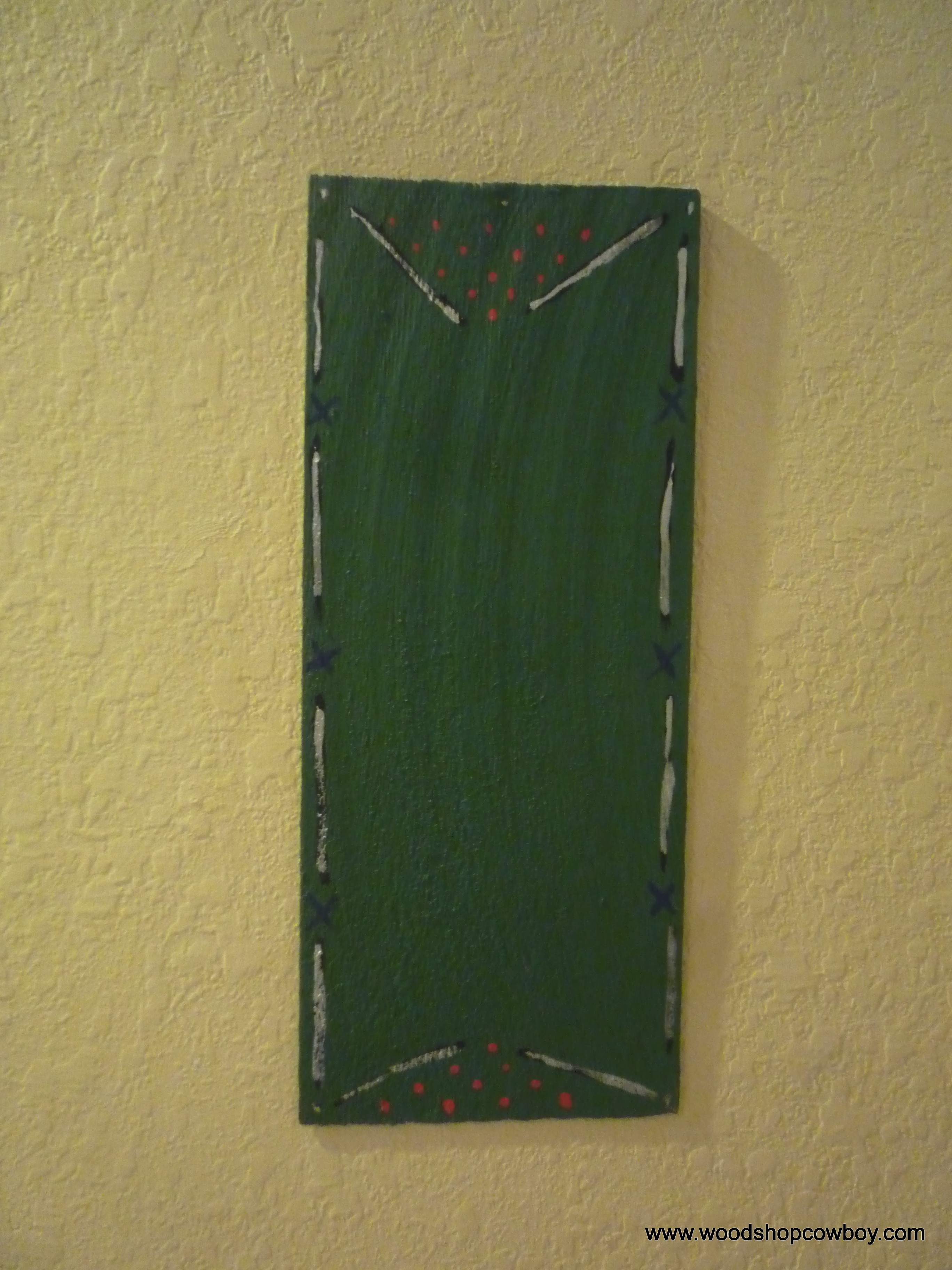
Back in the fall I built a bike barn. It’s more of a third-world shanty, but it housed the bikes and kept them sort of organized. Either way, I picked up a large number of cedar shingles as a roofing material. Time got away from me – I never roofed the barn. Instead, I used the shingles to create these cool little chalkboard slates. I used an exterior paint as primer, then covered them in green chalkboard paint. A couple of decorative touches later…
This slideshow requires JavaScript.
My second big project has been an exploration of flight using boomerangs. The summer program is themed around continents. I got stuck with Australia. Hence, boomerangs. Here’s a flight test of our third or fourth iteration of salvaged plywood boomerangs. Pick up the pattern here.
Make it safe & keep the rubber side down this weekend.
This spring, a sweet little book fell into my hands. Nina Tolstrup, an UK designer (she owns studiomama, a design firm). Her projects include lamps, scooters, wall planters, book ends and card holders – all out of One Block of Wood.
Ms. Tolstrup’s eye for function and style dovetails nicely with her habits of simplicity. While not every project is truly made from one piece of wood, each project involves a minimum of cuts and a maximum of flexibility. As a woodworker, I appreciate her style – as a teacher, I appreciate her clear directions, beautiful visuals and simple construction. I’ve used the little handbook a lot this summer – and students have been bringing home all sorts of handmade, kidmade, pridefound stuff. If you are looking for a crafts-centered introduction to the world of woodworking, take a little spin through Ms. Tolstrup’s plain-spoken world.
This slideshow requires JavaScript.
Make it safe & keep the rubber side down this weekend.
A few shots of the shutter table project. My students & I created these (there were four completed tables) tables using up-cycled window shutters & salvaged fence posts. Finished with spar urethane. Pocket hole joinery throughout.
Let’s consider the things that TED Ed asks the learner to do: watch a video, take a multiple-choice quiz, write brief constructed responses, and read through a bibliography. If I took the name TED out of this scenario, I would suggest that many educators would say that this format is exactly the type of traditional assessment that project-based, inquiry-driven, personalized learning is at odds with.
It is perfectly fine to watch a video. It is perfectly fine to view a lecture. It is perfectly fine to quiz yourself on what you remember from the video or the lecture. It is perfectly fine to write a brief response about a big question. But let’s not call that a lesson. That’s just a starting point.
My summer homework this year contains a unit involving Kahn Academy. I’ve listened to the critiques of both my colleagues and Dan Meyer on internet tools and I think the answer is pretty simple.
As a teacher I collect as many tools as I can to put in my toolbox. Some tools are used 80% of the time. Some tools are used 20% of the time.
But the most important tool is the tool I need right now. In this instance, it’s a old-school-pedagogy with a Web 2.0 twist. I don’t think all of my children will succeed or use it to its highest potential. Its just a great way of encouraging my kids to explore math in a “non-traditional” way. Even though it’s traditional.
Computers don’t actually make a Maker classroom, computer access does. In the past to years, I’ve developed an instinct, capability and ability to integrate the technology into our science and math-based classroom activities. Not every project needs computer (for example, the spirograph build) but many projects can be enhanced with its use. My students use a computer almost everyday; researching the day’s project, finding working examples and interactive demonstrations online or better yet, actively engaging with their small corner of the online world. A Maker’s classroom without computers can still work, but becomes harder to facilitate.
9. Alice Programming Environment
Currently in beta, developed in part by Randy Pausch and sponsered by Electronic Arts, the Alice Programming Environment provides a free, useful sandbox for students to learn the basics of computer programming. No, its not a powerful, high-level language like Python, nor does it have many applications outside of a the program itself (like say, Arduino’s sketchpad) but students learn logical thinking, loops, conditional structures and the like. This high-level of abstract thinking immediately transfers to other areas of life. My students often have to use conditional structures when planning a get-together (if I invite John and he doesn’t like Stacy then I can invite one OR the other) or completing multi-step, sequential projects (finish step 1, move on to step 2, check during step 3, go back to step 1). This type of abstract thinking comes naturally with age and cognitive development. When you teach a population challenged by exectutive functions like I do, any tool which allows students to practice these skills in an explicit way gets on my personal top ten.
8. Google Sketch Up
If you are looking for the most bang for your buck, find a way to incorporate Google Sketch Up in your room. I use GSU8 as a baithook, as a reward for strong academic performance, as a product creator, a academic break activity, as a curriculum enhancer, as the “cool” homework, as “can you believe this, parent? Look how competent your child is!”-bragging rights maker. I bait the kid with computer time and hook’m into learning geometry concepts, I reward twenty mulitplication problems with five minutes of worktime. My students create castles and learn spatial skills placing firing arcs from the catapults. My students create designs for headphone holders and houses and Borgian libraries. My students thrown tantrums and ten minutes designing furniture calms them down. My students turn in homework when I say the fateful words, “build it on Sketch Up”. My parents shake their heads in disbelief and new wonder. Familiarity with a program like GSU translates to coursework in college, into certificates in industry, into a career.
Perimeter/Area/Polygon Exercise in Google Sketch Up
Bang for your buck.
7. The support of community experts
Despite what my students may think about me, I don’t know everything. But I know a lot of people who do, and if I don’t, I know people who know a guy. Community experts mean I can do more with less and I can do more than I know how to do. I just have to ask and listen. I just become a facilitator, rather than a traditional teacher, for my own kiddos. I get the opportunity to occupy a different, more equitable and just as powerful space. My classroom thrives.
For those in Houston, look out for my Community Watch tag. I try to give credit when credit is due.
6. The woodworking tool box
Last summer, I started working on this toolbox. It holds various hammers, chisels, squares, sliding bevels, saws, tools and supplies for four to six students to build nearly anything with wood. This box contains magic. Absolute magic. If I can’t make it with the contents of this box…
…then it is beyond the scope my middle school curriculum.
5. A blog
Once a student is done listening to a lecture, performing an experiment, finding a solution and wrestling with a problem the student must process their new-found knowledge. Communication – whether short answer on a test, long essay on a bulletin board or oral presentation – provides the best opportunity for a teacher to evaluate their student’s learning progress. Student-centered blogs provide a quicker turnaround, leverage a student’s love of technology, allow practice zones for literacy skills, support multimedia integration and boost parental engagement all at the same time. The Math/Sci program produced roughly 80 posts this year. Some 2000 page views. We had twenty students contribute to these articles. That’s four essays on math/science learning per child. I teach science…but my kids can write. That’s a whole lotta communication.
4. A team of expert, engaged, bad-mamma-jamma professional educators
In the words of Arlo Guthrie – “One man singing a bar of Alice’s Resturant, then that man’s crazy. Three men singing it…that’s a movement”. Teaching is an art, a craft and a sweet science. Artist need muses, craftsmen need tools, sweat and wood. And boxers need to be knocked around a little to “season them”. If you do this alone, you burn out. You do this with a crew of people you can rely on, you change the world.
And I’ve gotta helluva movement marching with me.
3. Eyes and Ears
I carry a camera with me at all times. The camera records my students’ smile, my students’ learning, my students’ simple moments of success. If I don’t record it, I don’t share it, I don’t put it in my students hands and say “Remember this. This is important,” then it didn’t happen. The camera preserves my students’ success.
My colleagues use the discontinued Flip cameras to record video. We edit the video in MovieMaker and move it over to a YouTube channel. Other teachers can see our work, parents can look over our shoulder, the boss-upstairs can say “this is what our teachers do.” My eyes and ears give context and visual ooomph to any project I can develop.
2. WD-40, Hot Glue, Vice Grips & Duct Tape
Use them in this order. Always works.
1. A school which provides the space, curriculum and materials for exploration
My plea for you – especially if you are not already engaged in education – is to find a school which promotes Maker values and Maker projects and support those programs the best you can. Lend your expertise, donate used tools, put your dollars and voice behind hands-on education. Individual teachers, like myself, can only do so much inside a classroom. We need support on the streets, on our speed-dial and in the hearts of our parents. Hands-on, project-based, maker-centric education works and we need your help to get it to the next level. Keep talking, making and setting things on fire until our principals, superintendents and school boards sit up and take notice.
Make it safe & keep the rubber side down this weekend.





 WSC Designs