Home #Makerspace: A Small Bookshelf Using Only Hand Tools

This week we will build a small, simple shelf to practice our hand tool skills.  We will learn the rip cut and how to use the coping saw successfully.  We will assemble and hang our shelf using wood screws, the quickest fasteners around.

This project can be completed in a 15 to 20-minute session by a 8 and up maker.  Young makers will need help and encouragement to complete the long rip cut.  To install, I use drywall anchors and screws.


The Small Bookshelf


Material

  • 1” x 12” x 14” pine board or similar.
  • 2 #8-1 1/2” wood screws, #2 Phillips Head

dsc_1729

Tools

  • Woodworking Vise or Clamps
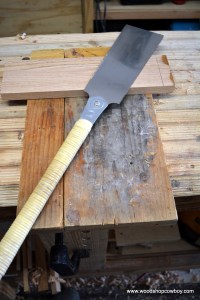
  • Ryoba or Panel Saw
  • Bench Hook
  • Jointer Hand Plane
  • Coping Saw
  • Sanding Block w/ Coarse Grit Sandpaper
  • Clamps
  • Hand Drill & Brad Point Bit
  • Countersink
  • 3-Jaw Chuck Brace & #2 Phillips Head Screw Driver
  • 1/2” Forester Bit
  • Combo square, panel gauge or mortise gauge to mark rip lines
  • Pencil


Dimensioning


The first step in dimensioning lumber  is to Rip to Width.  While I give specific measurements here, the general steps remain the same no matter the project or board.

  1. Use a combo square to mark a strip 4 1/2” from each edge. dsc_2464
  2. Position the board for a rip cut as shown in a vise.
  3. Saw along your marked line using the rip side of the ryoba saw or a rip-toothed panel saw.  Go slow and concentrate on your form.  If you veer off the line, try using slight wrist pressure to push the cut back to the line.  If you find yourself in really bad shape, you can flip the board and begin on the opposite side.
  4. When you reach the halfway point of your cut, flip the board in the vise and begin cutting on the other end.


Next, we Crosscut to Length.  Depending on your project, it might make more sense to cut to length before ripping to width.  These two steps are interchangeable.

  1. Mark the one of the 4 1/2” strips at 12”, then mark it square with the combo square.dsc_1759
  2. Position the board on a bench hook or work surface for a crosscut as show.dsc_1765
  3. Saw along your marked line using the crosscut side of the ryoba saw.  Go slow and concentrate on your form.


Next, we will Joint the Edge.  If you don’t have a jointer plane, use a long block with very rough sandpaper glued to its face.

  1. Match the machine cut edges together.  Secure the two boards, ripped edges up in the vise.
  2. Joint the edge with a hand plane.


Marking and Layout

  1. Mark the curves with a compass and pencil or use a round object as a template. dsc_1767
  2. Mark the location of the screws on the top shelf.  They are 2” inches from each end and 3/8” of an inch from the long edge.
  3. On the wall board, mark out locations for anchor screws.  The boards are 2” from each short end, centered on the board.


Cutting the Curves

  1. Use a coping saw to cut the curves.  Secure the work piece in the vise.  Go slow and concentrate on your form.
  2. Once the curve is cut, use sandpaper and a block to even out the curve.


Assembling the Shelf

  1. Secure the wall board in a woodworking vise, with the long edge facing up.  Place the top shelf in proper position and secure with clamps to the wall board.
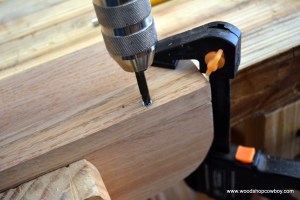
  2. Use the hand drill to drill pilot holes. dsc_1776
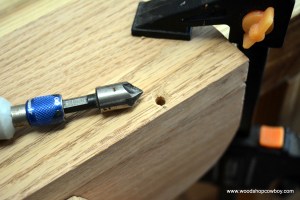
  3. Use the countersink to ream the pilot holes.dsc_1779
  4. Use screwdriver or brace & bit to driver screws.dsc_1781
  5. Remove the shelf from the vise and place on the bench hook.  Clamp to work table if you can.  Use 1/2” Forester bit & brace to drill at 3/8” deep hole.  Switch to a brad point bit the same size as your anchor screws and drill through.


Sand and Finish

Sand and finish as desired.


To install, I placed the shelf on the wall, checked to see if it was level, then marked the anchor locations.  I then installed dry wall anchors at those spots and attached the shelf.

dsc_1814

This design is only appropriate for short, shallow shelves loaded with light objects, such as knickknacks and personal electronics.  Heavy objects will rip it out of its anchors.


Thank you for your continued support.

Thank you for visiting my blog.  To support for this site, please like WoodshopCowboy on Facebook or follow me on Twitter, Pinterest or Instagram.  If you are interested in making and education, why not check out Work Notes, a curated set of Maker articles from the web, published every week?

This Week in the Shop: Spalted Red Oak Nightstand

This week in the shop, my brother-in-law and I completed a simple nightstand.20161025_135644-collage

This build offers a few interesting notes in its construction:

Pocket holes make for a strong, quick construction.  I almost always opt for pocket holes when teaching or practicing a form.

Oil finish bottom coat under a rubbed on shellac sealer.  This has to be my favorite finish of all time.  I also like to spray the top coat with a low-cost HVLP sprayer.

Lastly, we didn’t use any plans for this build, just proportions.  Check out George Walker & Jim Tolpin’s By Hand & Eye for a deeper look into proportional construction.

This slideshow requires JavaScript.

Thank you for your continued support.

Thank you for visiting my blog.  To support for this site, please like WoodshopCowboy on Facebook or follow me on Twitter, Pinterest or Instagram.  If you are interested in making and education, why not check out Work Notes, a curated set of Maker articles from the web, published every week?

Tool Primer: Hand Saws for #Woodworking

Every tool has a purpose.  The Tool Primer Series explores common #makerspace and #woodworking tools.  You can check out the entire series here.

When a problem’s too big in my shop, I cut it down to size with a hand saw.  Hand saws have several inherent  advantages over power saws.  They don’t run out of batteries, so makers can use them all day.  The light weight means novice and  smaller makers can comfortably use the tool reasonably safe.  Hand saws can make delicate joinery and also rip through 3” slabs.  No circular saw or table saw has that type of range.

dsc_1912

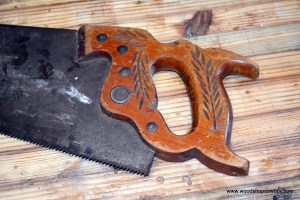
Hand saws are not made equal.  Each hand saw excels at certain tasks.  In this tool primer, we will examine the Western & Japanese-style divide, learn to match the saw to the cut direction and classify saws by type and function.

Continue reading “Tool Primer: Hand Saws for #Woodworking”

Home #Makerspace: The Bench Hook is a Secret Weapon for #Woodworkers

Bench hooks are portable work surfaces used to make basic woodworking tasks, such as crosscutting boards and drilling holes, easier to perform.  As a bonus, they help protect the surface of your woodworking bench from bumps and dings.

In the makerspace, bench hooks can be used for numerous tasks and roles (such as a surface to solder on without ruining Mom’s dining room table).

This slideshow requires JavaScript.

These week, my youngest and I made two bench hooks.  The most common design works best with saws that cut on a push stroke.  We also made and tested a bench hook modified for pull saws.  Bench hooks can be modified in numerous ways, so take the jump and get hooked!

Continue reading “Home #Makerspace: The Bench Hook is a Secret Weapon for #Woodworkers”

Home #Makerspace: Halloween Pumpkin String Lights #3DPrinting #makered Project

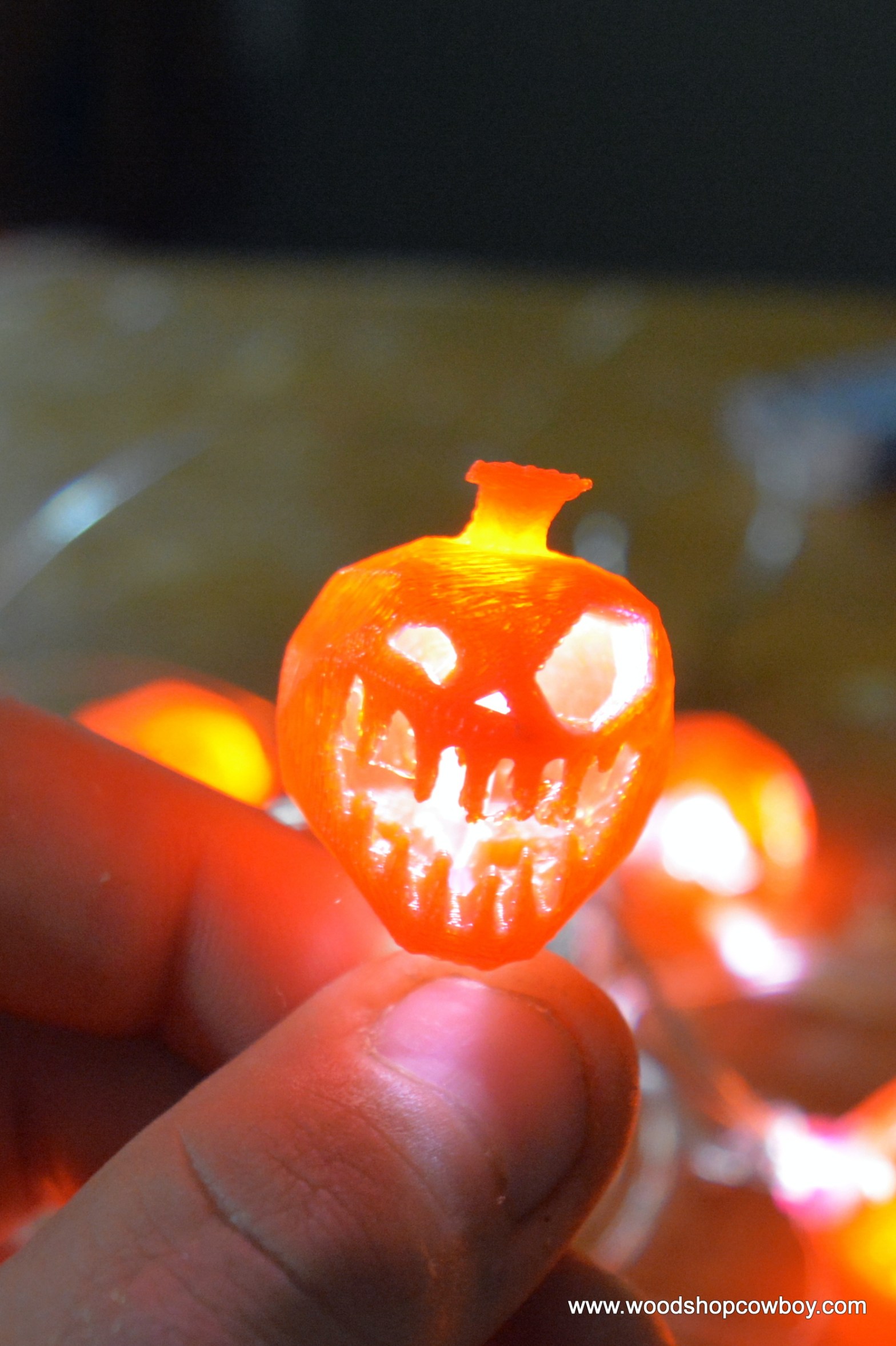
dsc_1658

Here’s a great “getting started” 3D printing project for young #MakerEd students.  It combines rudimentary circuit knowledge, gross motor skills and safe tool use.  It costs about $5 to make (excluding the cost of a 3D printer) and can be modified to fit any holiday, not just Halloween.

These pumpkin string lights are appropriate for young makers K and up.  While this version uses glue guns, safety conscious adults can use blue tack or sticky wax instead.

Continue reading “Home #Makerspace: Halloween Pumpkin String Lights #3DPrinting #makered Project”

Home #Makerspace: Simple Kid’s Game Boards for Young Makers #Woodworking

For young children, games aren’t just fun – games provide vital, necessary childhood lessons.  Games teach us to deal with loss, how to cooperate, work towards a goal and become devious, clever problem solvers.  Games teach us sportsmanship, grit, toughness and grace. Games teach us who we are and ask us to become better versions of ourselves.

This week, we made a quick foldable checkerboard inspired by my youngest child’s love of the game.  This basic folding design can expanded and modified to play any board game.  Just let your imagination run wild!

This project incorporates measuring, marking boards square, using a hand drill and hand saw, and an all natural, no-fuss stain (although it is stinky!).  Super quick, super cheap and super easy for young makers between K – 3rd grade.


The Simple Checker Board


Materials:


Gameboard:

1” x 6” x 20” of #2 Common Pine Board available at any big box store.

2 small hinges.  These are 1” long with 2 screw holes.  Available at the big box hardware stores.

#4 – 1/2” wood screws.  Really small and they use a #1 Philips head.

dsc_1534

Finishing:

Black acrylic craft paint.

Ground tumeric & used coffee grounds.

Paper cups.

Paint brush.

Blue painter’s tape.

Marker or pencil.


Tools:

Combination Square at least 12” long.

Hand drill

Screwdriver

Hand saw.

Woodworking Vise.


Dimensioning:

1) Use the square to measure 11” from one side.  Use the square to mark your cut.


2) Clamping the wood in the vise, saw down the line.  If your young person has trouble sawing a straight-ish line, start the cut for them.  Check out other tips in teaching young people to saw here.

dsc_1554

3) Repeat process to make another side.


Assembly:

1) Place the two boards next to each other to form a square.


2) Place your hinges as shown, then mark the holes.


3) Pre-drill with a hand drill and very thin bit (or finish nail), then screw down hinges.

Finishing:

1) Sand edges

2) Draw your game on the board and play!

dsc_1575

Checkerboards:

1) Cover the board with blue masking tape.

dsc_1584

2) Using a ruler, mark out an 8” x 8” square, centered on your board.

3) Using a ruler, mark out 1”x1” squares on the board in a checkerboard pattern.

3) ADULT ONLY:  Using a utility knife, run over the marked lines, cutting the pattern.

4) Remove the bottom left square.  Continue in a checkered pattern.

dsc_1595

5) Paint the exposed squares with black paint.

6) Remove the tape mask.

Natural Stain:

1) Mix used coffee grounds and turmeric with a slight amount of boiling water.

dsc_1605

2) Dribble the resultant sludge all over the project.

dsc_1604

3) Wipe down with paper towels & vacuum up with a vacuum.  The turmeric WILL STAIN EVERYTHING IT TOUCHES!

4) Let dry.

dsc_1613

Thank you for your continued support.

Thank you for visiting my blog.  To support for this site, please like WoodshopCowboy on Facebook or follow me on Twitter, Pinterest or Instagram.  If you are interested in making and education, why not check out Work Notes, a curated set of Maker articles from the web, published every week?

This Week in the Shop: Stackable Storage Boxes #Woodworking Project

This week, I built a 8 box set of stackable makerspace boxes.  This design can be accomplished using three power tools (router, miter saw and jigsaw) and the design can be adjusted to fit your space and needs.


The dimensions given work for boxes made with 3/4″ plywood.  If you use thicker or thinner plywood for the sides, your dimensions will change.  Double check your measurements before cutting.

 Continue reading “This Week in the Shop: Stackable Storage Boxes #Woodworking Project”

#Makerspace Tour: KID Museum in Bethesda, MD

The KID Museum of Bethesda, MD offers a range of Maker activities through outreach, studio time, open play/build and structured classes.  It’s open for drop-in visits on weekends and reserved for workshops, school trips and scheduled events during weekdays.


This slideshow requires JavaScript.

We visited for open house Sunday hours recently.  It cost $8 per person and admission included access to about ten stations, all managed by young adult makers.  The staff was friendly, helpful, diverse and knowledge.  Kudos to management for finding such excellent and kind teenagers in the world.

The KID Museum has some really cool projects I want to translate into the home makerspace, such as homemade wind tunnels, wood & metal erector sets.

Kid-centered spaces such as KID Museum can change a young person’s life – these are the places dreams come true.  Even just visiting opens up a young maker’s vision of what can be possible.  Visit a makerspace today.

Thank you for your continued support.

Thank you for visiting my blog.  To support for this site, please like WoodshopCowboy on Facebookor follow me on Twitter, Pinterest or Instagram.  If you are interested in making and education, why not check out Work Notes, a curated set of Maker articles from the web, published every week?

Home #Makerspace: Making Geometric Nets with Vinyl Cutter

In this project, young makers use a vinyl cutter to cut and score geometric nets, connecting 2D shapes to 3D prisms, polyhedrons, etc.  They learn to recognize the difference between two and three-dimensions, while also seeing a relationship between the two.  Lastly, this is a great opportunity for fine motor skill practice.  The plastic requires superglue to connect, but paper nets can be assembled with hot glue or glue sticks.

dsc_1444

Continue reading “Home #Makerspace: Making Geometric Nets with Vinyl Cutter”