Tool Review: Marples’ Japanese Style Saws

Some new gear found its way into my home-shop.  I’ve recently bought the Marples/Irwin-branded version of this saw by Shark:

Ryoba!

The manufacturer patterned this saw after Japanese ryoba saws.  Some quick thoughts – it has two saw blades.  The larger teeth (the 8ish ppi) side seems to excel at ripping, while the 17ppi side excels at cross-cutting.  I have no idea whether the saw was designed in this way, but that’s the way she works for me.  It’s two handed design allows the saw to cut quite fast and straight.  Bench hooks seem to be completely useless though, so to use one, I need a vise of some sorts to hold work steady.  I’m unsure if there’s a way to use this guy one-handed, similar to a Western saw, although there are pull-saws which are designed to do so.  If I had a perfect vise in the workshop at school, instead of the semi-decent stuff I have now, I might think about these in a classroom setting.  At the moment, I’ve found a replacement for my backsaw and toolbox saw.  In the home workshop.

I also picked up the dovetail pull-saw.  What a sweet little machine.  Here’s the saw,

Dovetail pull Saw

and a shot of a half-lap joint I cut with it. One comment.  The blade is semi-fragile.  I managed to kink it within a few hours of use.  I probably just wailed on it to hard.  So watch out.
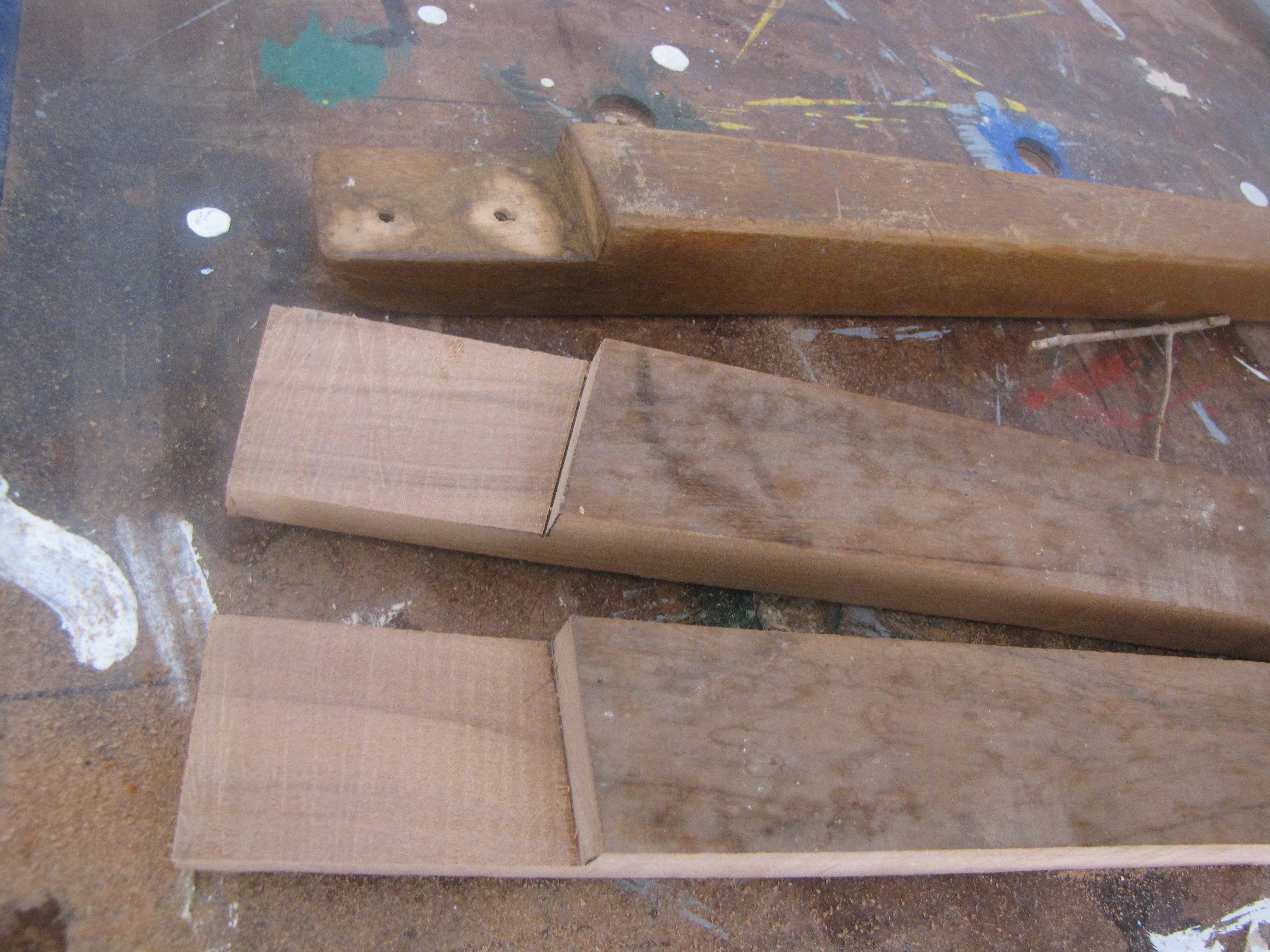
The Dovetail Saw cut the two on the bottom. The top joint is the part I'm trying to replace.

I hope this puts a few new options in your saw sheath.  So you can be like Julis Ceaser.  You came, you saw, it fell in two.

Make it safe & keep the rubber side down this week.

This Week in the Shop: Cardboard Prototypes

This week’s word:  Prototypes.  Brought to you by the letter C for cardboard.

What a week!  My students spent last week drawing and planning and designing and planning and planning.  We got outside this week!

My chair group is off to a fast start.  Both “makers” have created cardboard prototypes for their chairs, while the “mending” crew has put a coat of pink acrylic on a repaired kitchen chair.  I will be milling parts this weekend to save my students some construction time.

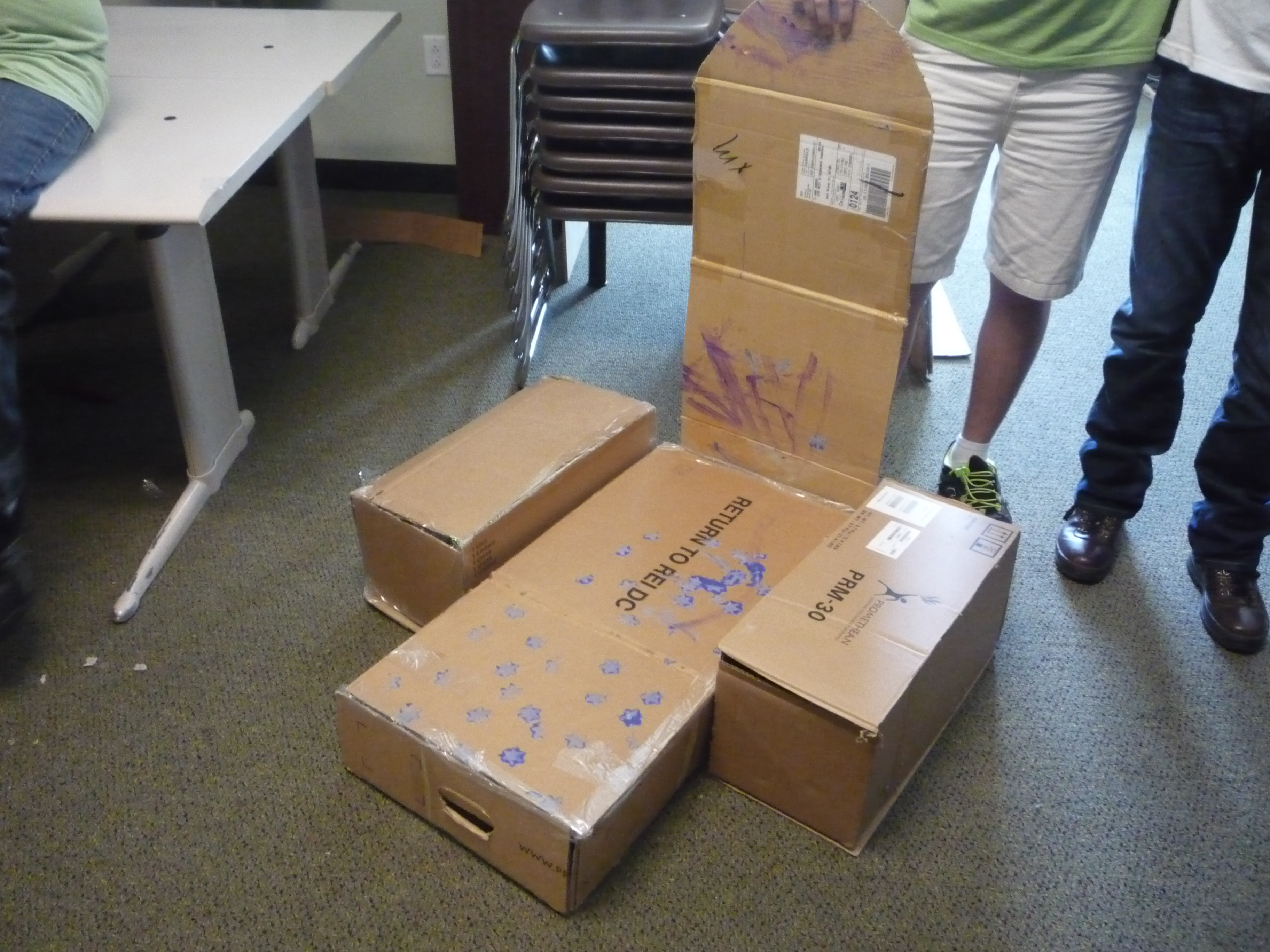
The drum casings have been prototyped also (I was looking for sizes and the students could get a feel for the construction process).

Bigger and better next week!

Make it safe & keep the rubber side down.

This Week in the Shop: The Cajon Drum

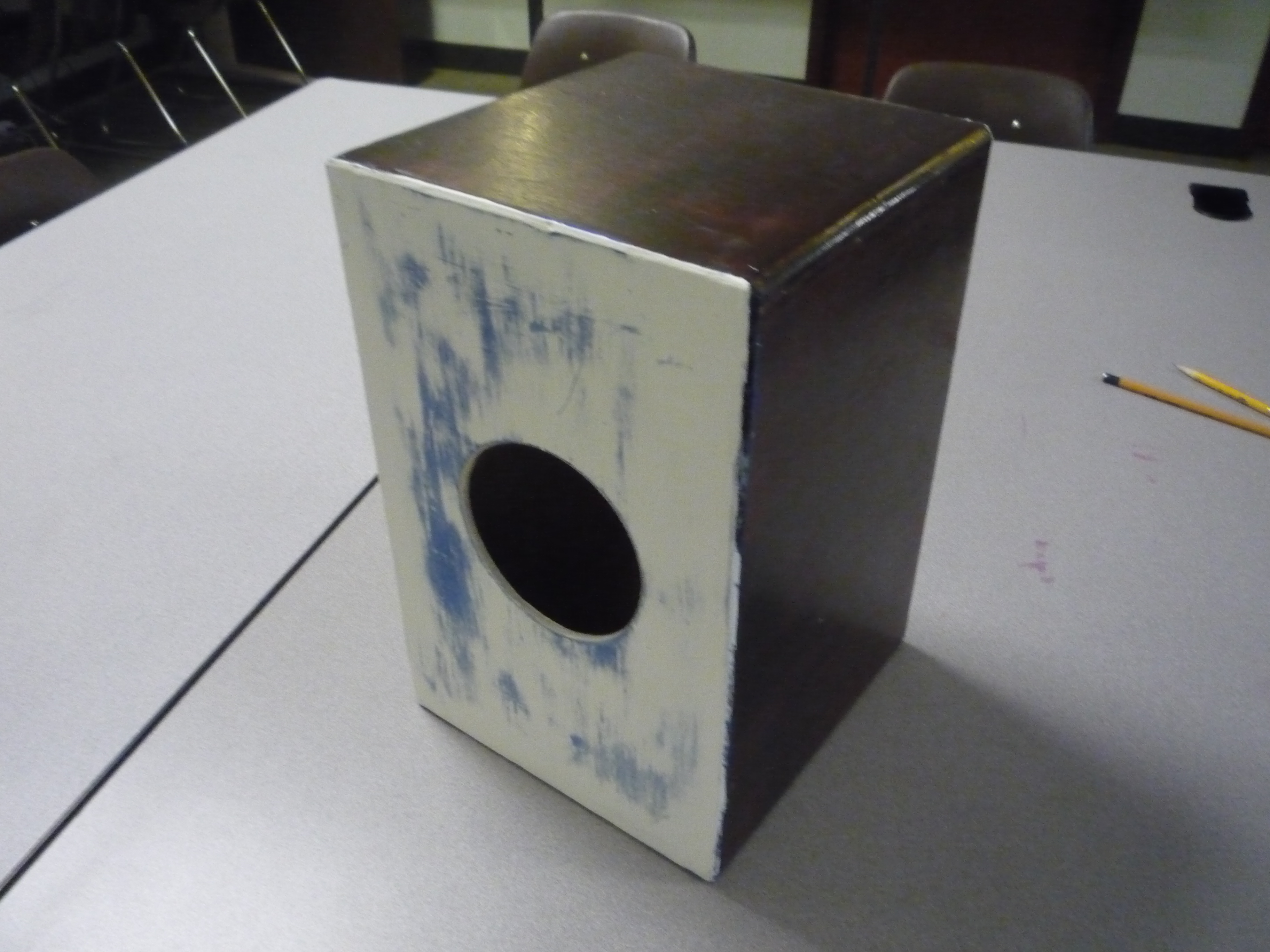
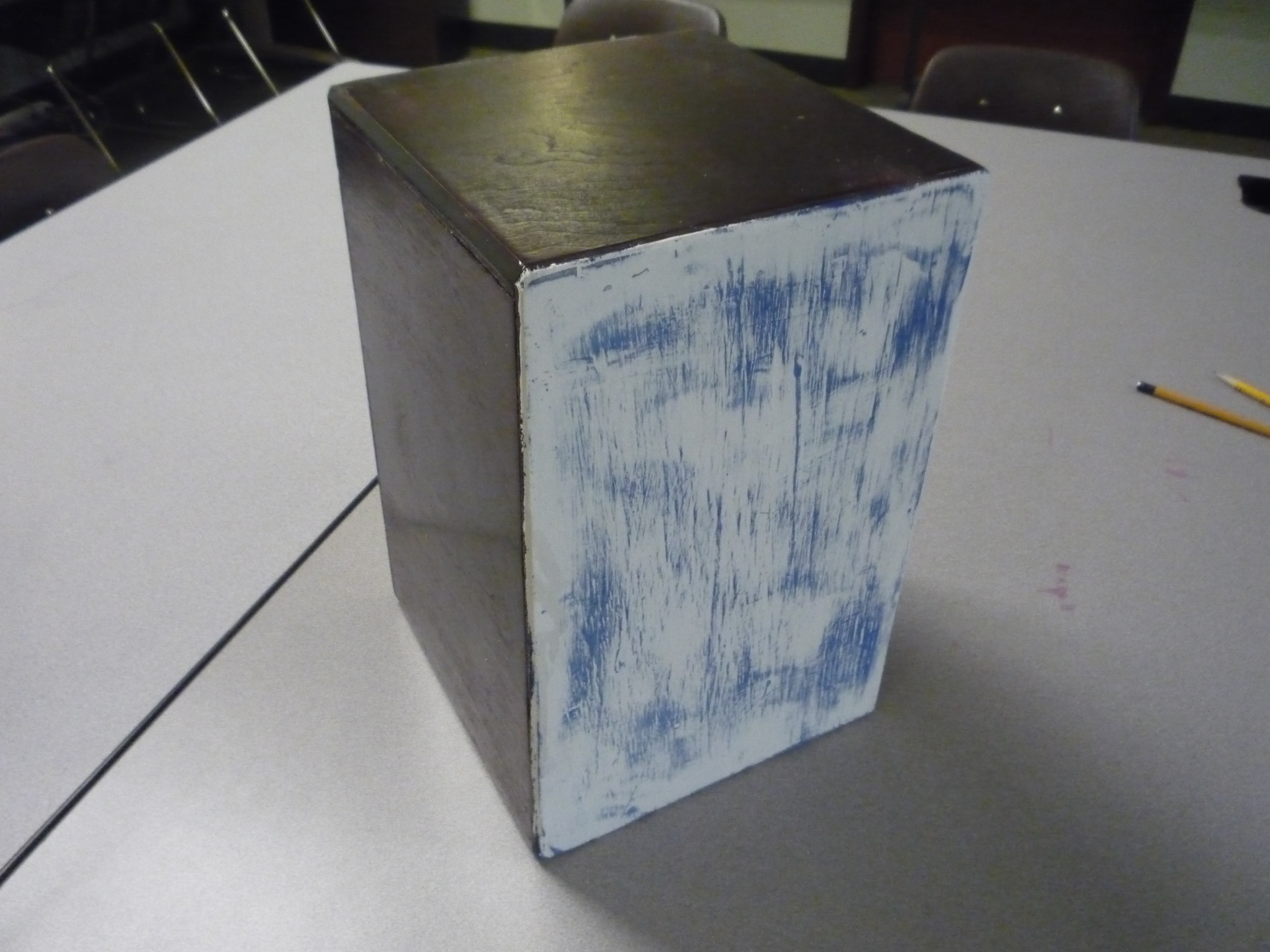
This week, I prepped for this summer’s woodshop classes.  The students will be building these benches, mending and designing chairs and constructing Cajon drums.  I’ve secured enough lumber for the benches, pulling plywood chair designs from various sources and built this example project.  Look to the above link for construction details.

I finished the sides in Miniwax Polyshades.  Acrylic paints cover the top and rear .

And how it sounds!

Tool Primer: Painting A Room

In February, I learned the necessity of insurance, family, cash-in-your-pocket and good-quality plumbing.  My house flooded – and I’m talking spectacular water-from-the-ceiling, I-hope-this-never-happens-to-a-house-I-own flood.

Every room in my house received flood damage.  We moved out for a month and the landlord gave us a new house (ok, his insurance did).  I will say this: we got lucky and it could have been worse.  I saved our expensive things from harm, my landlord had insurance.  This could have gone worse.  I count my blessings.

As the contractors worked tirelessly to fix the damage (new lighting fixtures, new kitchen, new floors, new carpet, new tiles, new paint, new drywall…..), I painted my boys’ room.  Some results:


The Tool Primer for Painting a Room after the jump!

Continue reading “Tool Primer: Painting A Room”

(School) Year in Review: Art Car 2011

As I gear up for summer program, I will be taking a little time to reflect on my past year. My bosses at work have kept me on as a teacher, although I smell the terrifying and exciting smell of change in the air.

On May 22nd, my students (and I) participated in the 2011 Art Car Parade. You can catch some parade pictures here and the winner’s list here. I blogged about the build process here.  The cost of this project: $30.  Re-used lumber, re-used paint.  I even got to reuse the sheet metal screws from my last Art Car project.  I only spent my budget on screws and liquid nails (great stuff).

A project like this, building a mocked-up moving land shark, is a lot of fun.  I get to teach some basic power tool skills, my students have to work as a team and learn some important life lessons: patience, dedication and the realization that sometimes, things are worth doing because they are simply worth doing well.   How does this translate into academics?

Well, I’m not always sure.  My students drafted designs, researched mechanical difficulties in Ford trucks, measured and cut numerous parts.  Will this show up on a bubbled-in test?  No.  According to Texas’s education standards, I may not have taught them anything that can be measured – and therefore, I didn’t teach them a thing.  If I could post a picture of my students gathered around their Art Car and you could see the look on their faces, I think I could change some hearts and minds.  I think I taught them pride in themselves.

Scratch that.  I didn’t teach them pride.  I found a way to allow my students to build pride in themselves.  With their hands, with their minds and with their hearts.  And most importantly, with a smile on their faces.  And I wouldn’t ever want to quantify pride with a test.

Make it safe & keep the rubber side down.

This Week in the Shop: Children’s Picnic Table

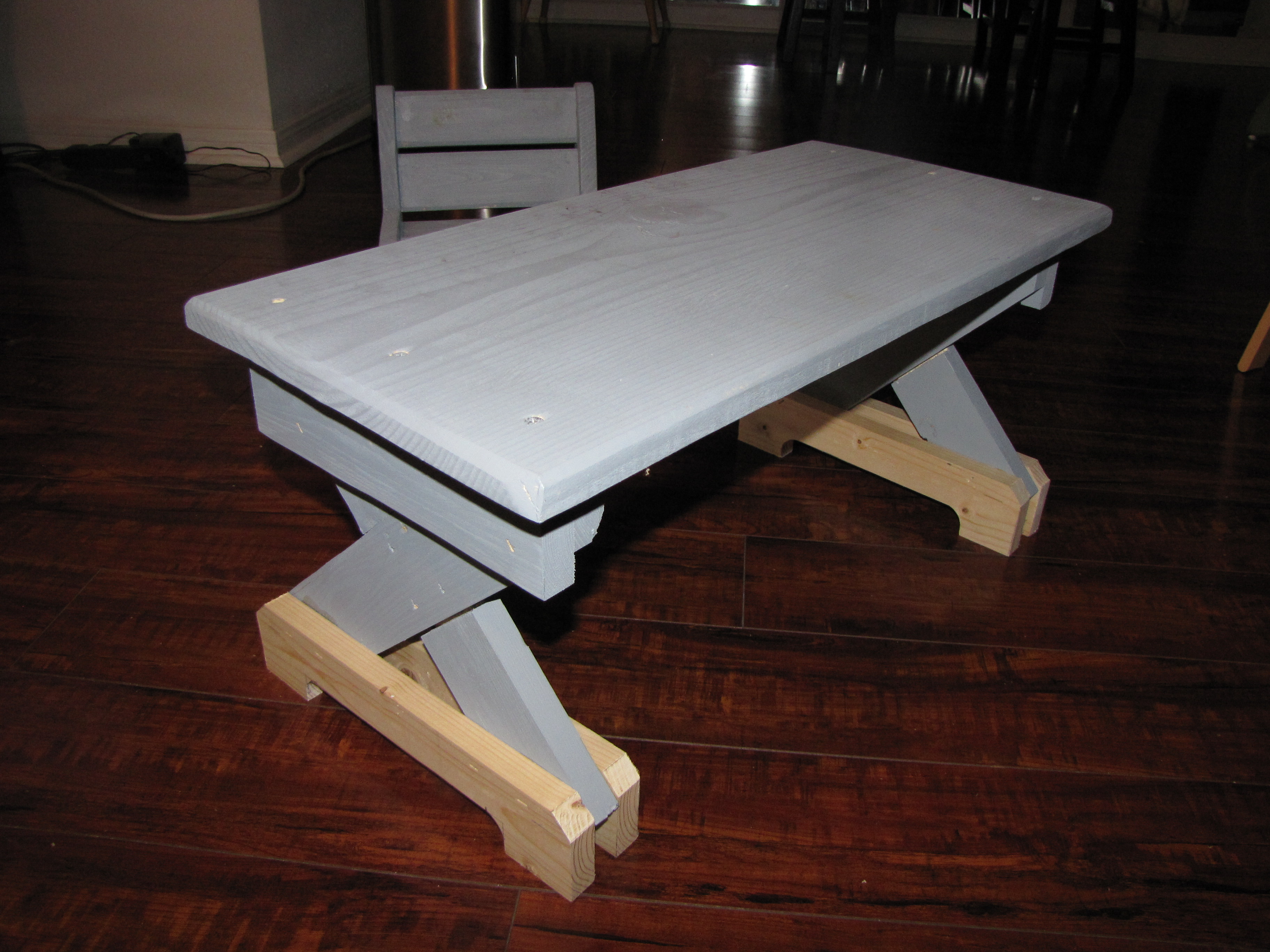
This week in the shop, I got the chance to use up a few of the pine boards laying in the woodpile.  My son got a picnic table out of the deal.  The table is 24″ L, 11″ W & about 11″ H.

The table:

The chair (the rails are too close together):

The result as he knows it:

A side shot of the chair.  It’s a little skinny:

I attached the top with a few screws. You can deduce the construction of the side with this shot.

Make it safe & keep the rubber side down this weekend.  I’ll be back next week with some year-in-review posts and hopefully, a picture or two of some wood drums I’m currently building.

This Week in the Shop: Reading Stand from Salvaged Wainscoting

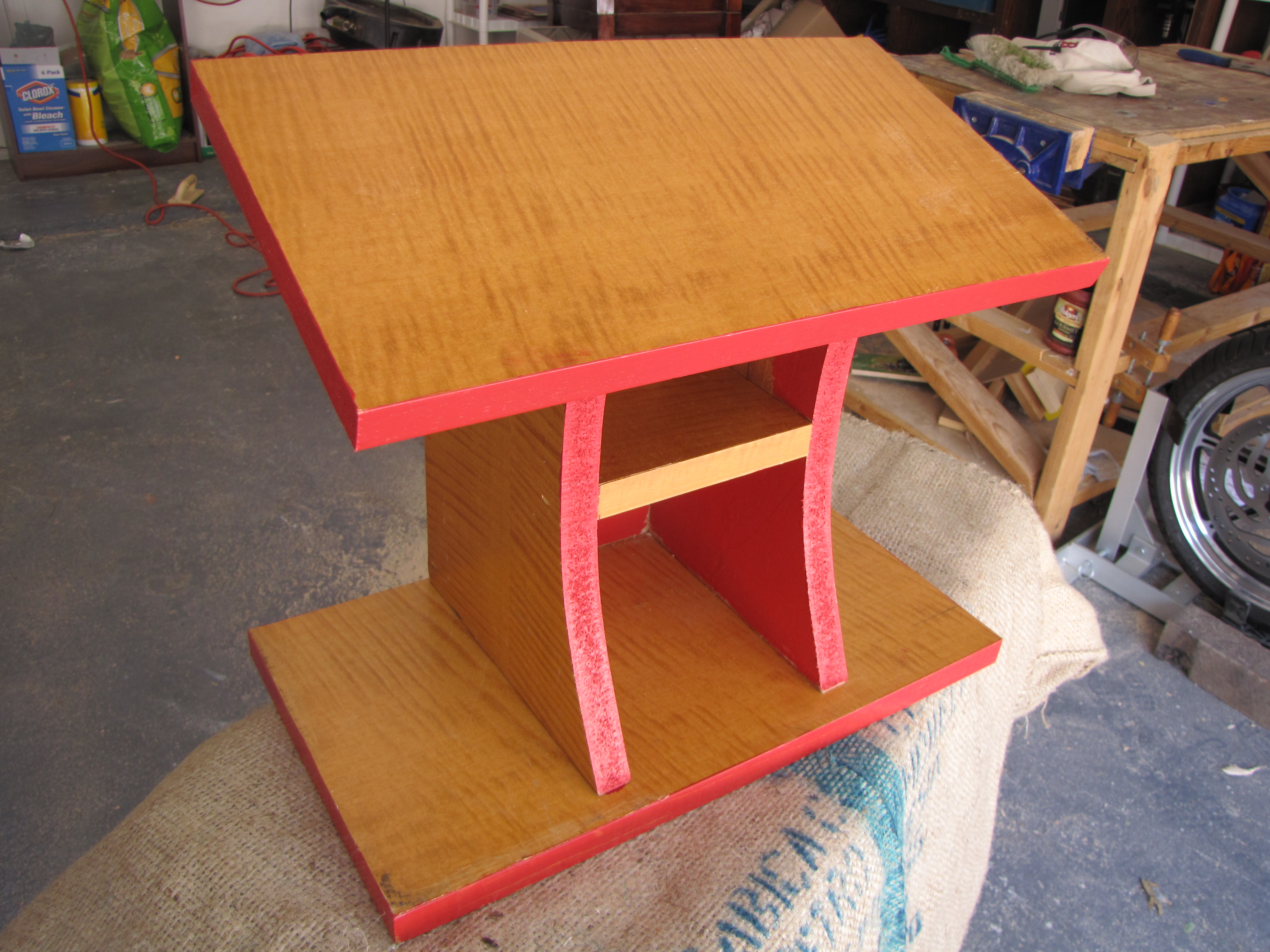
Here’s my latest workshop creation.  It’s a small reading stand for my wife’s grandmother (or rather, mine too, I guess).  The curly flame maple isn’t actual wood, but some sort of printed-Formica laid over some pretty expensive chipboard.  The Formica/chipboard came off a local office’s wainscoting, and I just had to grab a coupla panels.  The Formica cuts well with a panel/plywood blade in my circle/miter saw.  I still need to work on covering the chipboard up – I tried molding in this project and paint in this one.  I’m leaning towards molding after seeing the results.

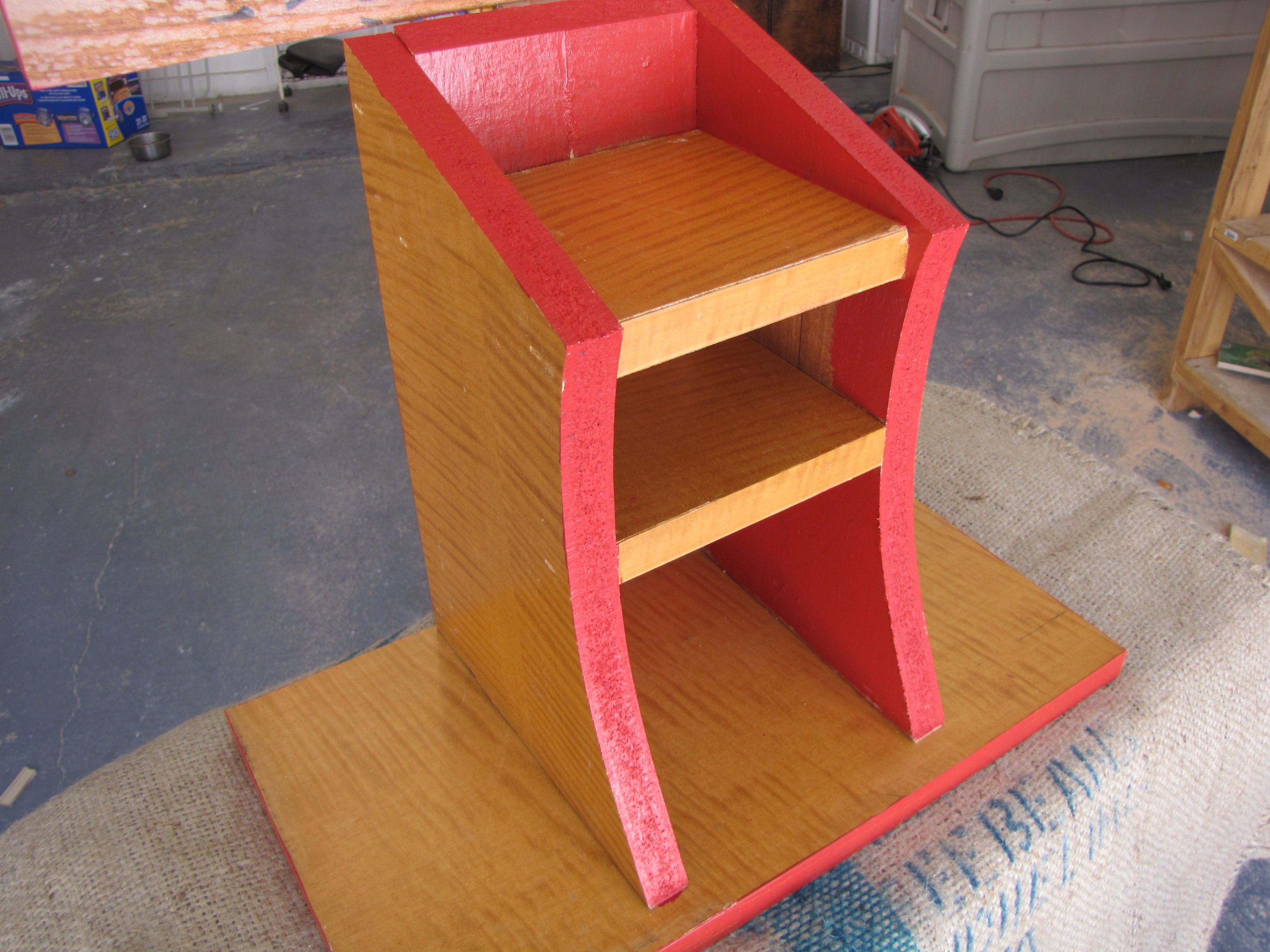
Now onto parts I like:  the proportions (16″ w x 12″ h x 8ish” d), the red/curly maple combo (red is also the color for luck in Vietnamese culture), and the reading angle.  After this picture was taken, I attached a clear acrylic strip on the bottom of board to hold books.

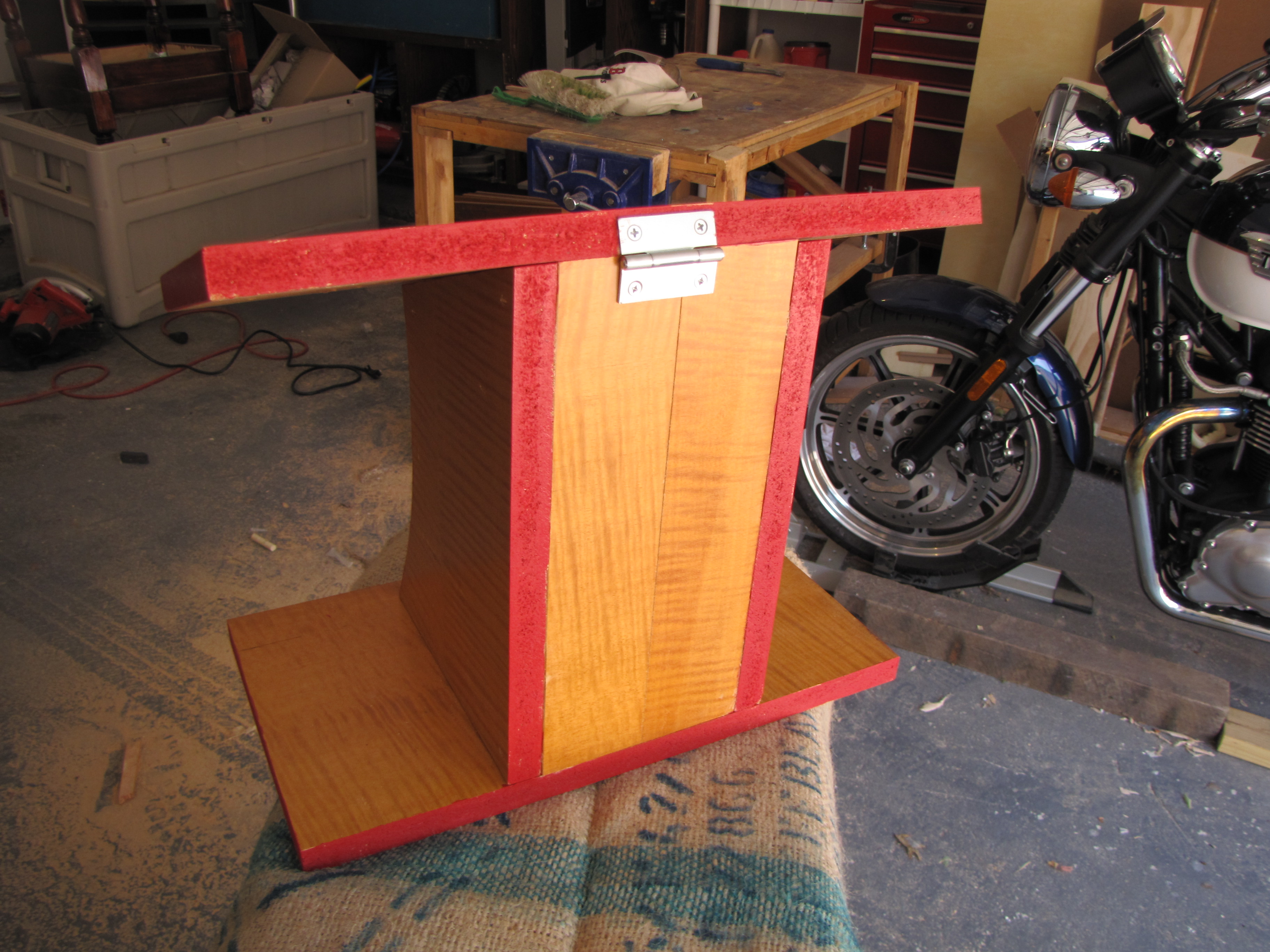
The back lifts of course.


And the back reveals that non-mortised butt hinge which shifts and stammers and really needs to be a piano hinge instead.

If you have any thoughts, love to hear ’em.

This Week in the Shop: A Granite Trestle Table (for Grillin’)

There’s a saying in electronic/maker/hacker circles. Sometimes, you just need enough junk before you can start doing cool stuff. You need a “critical mass” of stuff.  This trestle table came together because of a “critical mass” of junk.  The pressure treated base was scrap pieces from a variety of sources (work, my own projects, etc) and the top came from a neighbor’s remodel.  As any maker will tell you: if you don’t collect the stuff somewhere, you don’t get the idea to use it.  The process works and I got a cute little grilling table out of it.

A walk through of the build after the jump.

Continue reading “This Week in the Shop: A Granite Trestle Table (for Grillin’)”