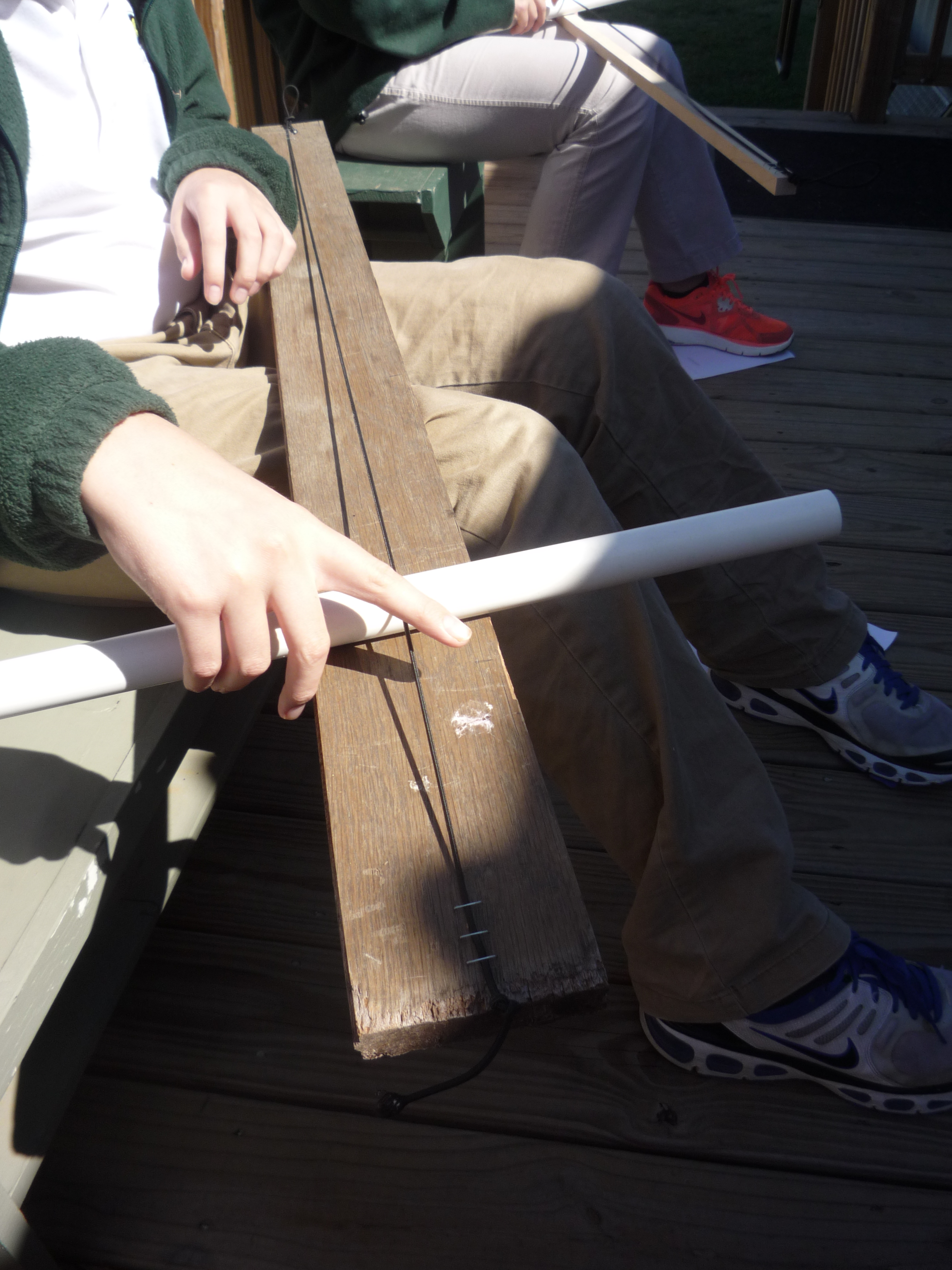
Make: Projects has great instructions on how to build your own diddley bow.
Make it safe & keep the rubber side down.
Maker Projects & Education
Make: Projects has great instructions on how to build your own diddley bow.
Make it safe & keep the rubber side down.
…soon. For those you in the Houston area, join us at the Art Car Parade on May 12th. More info at www.orangeshow.org.
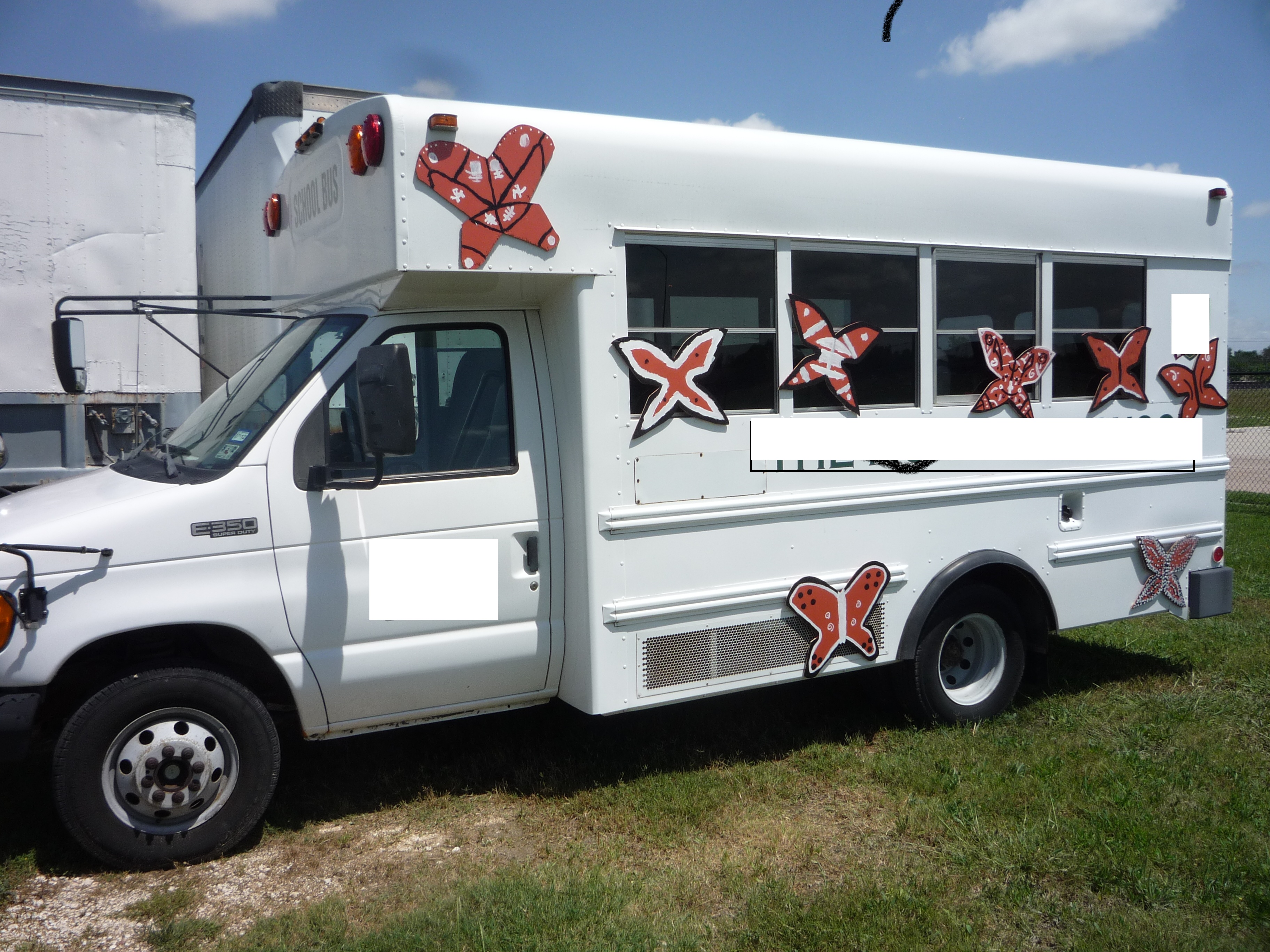
Make it safe & keep the rubber side down this weekend.
“The Venny” is one of only 5 staffed Adventure Playgrounds of its kind in Australia.
It’s a free community backyard designed for children aged five to 16 years old from the Kensington public housing estate and surrounding areas.
When I grow up to be a real adult…I’m building my sons (and the students around me) this playground.
Make it safe & keep the rubberside down.
In my middle school/junior high class, we’ve been exploring the relationship between sails, force, momentum, foam boats and area. I’ve used the unit to assess the graphing labs we conducted last quarter and introduce non-linear graphs.
This slideshow requires JavaScript.
I began the unit by asking students to research old sailing boats and draw conclusions from the material they gathered. The students completed a K-W-L chart. I then introduced the question: what is the most efficient sail?
After some fits and starts (we have been doing some standardized testing practice to get ready for this week’s Stanford tests) we realized we needed to ask two questions: What is the best SIZE and what is the best SHAPE?
I split the room into teams of two and had each team pick a different shape. Most chose some sort of triangle, but some had rectangular sails (from the team fixated on pirates) and trapezoids. We used this lab to develop a way to create different SIZED sails with similar SHAPEs.
Then, in a class discussion, the students designed the boat hull, which you can see in the slideshow. The hull allows for some cross-experimenting when it comes time to determine the best shape.
We used this experiment lab to record our results and blogged our conclusions.
Next week, I’ll have the group learn about momentum, re-create a force chart for the experiment and maybe calculate the actual force exerted by the wind on our boats.
The textbook is now digital but students still encounter it as they always have: wisdom to be received, perhaps highlighted, annotated, and memorized, but not created, constructed, or made sense of. Teachers still interact with students as they always have. The platform doesn’t offer them any new insights into the ways their students think about mathematics. As far as I can tell, the iBook doesn’t establish any new link between the student and teacher, or strengthen any old ones.
In my classroom, I have very few textbooks. They have their place in other classrooms but my students – students who have spent countless hours, literally years, of their life avoiding the very act of comprehensive reading – have no use for textbooks. Textbooks create visceral disgust within them. Everything which is unfair and wrong with the world, with them, with me, with this exact moment spills out like ill-placed illustrations, small text and incomprehensible, without-contextable, testable, contemptible chunks. You bring a textbook to class, expect ramifications. You may not have any students in your room.
Books. My students don’t want no books. They want experiments, conversations, ah-ha moments and excitement. Which is funny, because our school’s Lit Department has dropped some serious cash on Kindles, iPads and time developing Promethean Board projects. From the scuttlebutt – and number of Kindles which pop up like spring flowers in my classroom – the new flashiness gets eyeballs on words. My students are reading. My students are writing. My students talk more – to each other and me. I know this because unlike last year, I get two or three sentence answers to science questions. I ask for a blog post reflection on their work and the work is turned in complete. I assign project books as research materials and the students mark six projects in the book instead of two.
But if that’s the only trick – buy a flashy toy – then the 1:1 Laptops programs, Smartboards and iPads should’ve solved the “education” problem. Whatever that education problem may be. Word processors should have made every kid a writer in the 90’s.
So why doesn’t technology-alone engage students in academics? Christopher Danielson puts his own spin on what tends to happens to teachers when technology enters the classroom –
We tend to adopt the tool uncritically and use it without a tremendous amount of creativity. We extend current practices rather than use tools to change our practices. And frankly? I’d be a lot happier seeing more meaningful use of poster paper in more math classrooms. Let’s save the spending on Smart Boards until we’ve got that nailed down, shall we?
He’s specifically talking about the difficulties with Smart Boards (I use a Promethean). And as a relatively tech-savvy dude….he’s right. I don’t use the Promethean near as as effectively as I should. Have my student’s suffered? Probably not. The Promethean is a fine broadcasting tool. It’s a bit like an iPad textbook, or a fancy flashcard or TV – it broadcasts a small amount of information to a large group. Or just a textbook. Just a bit more interactive.
So what does work?
Economically disadvantaged students, who often use the computer for remediation and basic skills, learn to do what the computer tells them, while more affluent students, who use it to learn programming and tool applications, learn to tell the computer what to do.
Neuman, D. (1991). Technology and equity. Available at http://www.ericdigests.org/1992-5/equity.htm
AND
Those who cannot claim computers as their own tool for exploring the world never grasp the power of technology… They are controlled by technology as adults – just as drill-and-practice routines controlled them as students.
Pillar, C. (1992). Separate realities: The creation of the technological underclass in America’s public schools. MacWorld, 9(9), 218-230.
While the poor/affluent part of this quote can wait for a different post, the striking contrast between rote and constructive learning held true 20 years ago, and for the most part, holds true today. One classroom described in the Neuman quote sounds intriguing, the other doesn’t. My classroom involves computer programming through Alice, computer-aided design through Google Sketch-Up, mathematical modeling in Excel & Geogebra, airfoil designs in FoilSimIII and others. I can’t say anything I do is innovative, but I do do technology better’n most. I’m not particularly interested in whether or not my students can use a computer. I want to teach them how to use a computers.
Which brings me back to my first example. Didn’t I start this post with kids getting Kindles and suddenly becoming readers?
Well, that’s not completely true. The innovation in that classroom isn’t a two-hundred dollar device. A teacher stands at the center of the new vortex, asking students to build, create, research and learn in ways they have never done before and with questions they have never asked. You want to use the blowtorch in shop class, kid? Lemme download the safety manual for you. Here’s thirty questions on its use. Call me when you need help, a reader or you’ve got your answers. Finished the test? Make a video on its use. Blog about it. Teach a peer how to use one safely.
A friend of mine has a word for this learning environment: student ownership. That’s what I’m looking for, that’s the trick to teaching (and teaching technical literacy on the iPad).
If you are in the market for a 7-1/4″ circular saw for light homeowner use, I don’t see any reason not to buy a SKIL 5480. It’s cheap, durable construction, dead simple set-up and with a decent saw guide, can create clean cuts all day long. The hard plastic casing has held up to three years of abuse, the metal foot plate hasn’t rusted and kept its smooth action. It has a metal blade guard. It’s big enough to get the job done. Buy it. Skip the laser.

Indeed “play” and “hard work” are not opposites: in fact, they can be seen as synonyms. Anyone who has ever played hard also knows how to work hard. There may be aspects of our play that we dislike, that are not “fun,” but we do them because they are steps in the process we are teaching ourselves, the challenge we are undertaking. And young children tend to play hard, throwing themselves wholly into it, immersing themselves into it as they see fit, to the degree they feel comfortable, up to the point of their interest, until their driving questions are answered.And this is where [others] tend to interject: Ah, but what about the hard work of doing things they don’t want to do? How do you teach them that through play?The short answer is: you don’t.
I have tried for weeks to say this better than Teacher Tom. I haven’t succeeded yet. Check his blog out. If I had the chance to move to Seattle and send my kid to him, I would in a heartbeat.
As I’ve hinted at in earlier posts, I’ve officially moved my home shop (the Magic Shop, as I tend to call it) to my new home in suburban Texas. The move took nearly seven days to complete – two to three to move and another two or three for set-up. I’m very happy with the results.



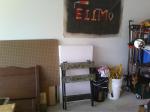


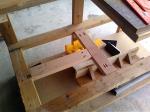
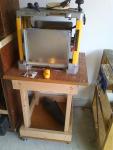
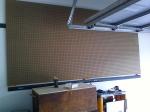
Two new additions to the Magic Shop this move – I’ve hacked apart my workbench/router table to create a bandsaw/router combo bench. I’ve also made a moveable stand for my planer. By designing the stand around my bandsaw/router table, I can use the bandsaw/router table as a outfeed table to boot.
Make it safe & keep the rubber side down this week.
My wife bought a beautiful used Craftsman couch for the new house. Unfortunetely, the previous owner had two young boys. Boys, as any parent knows, have an instinctual hatred of nice things. My parents used to run around my house yelling “this is why we can’t have nice things” at random intervals throughout my childhood life. Often, I would not actually be engaging in destructive behavior, but they thought judicious over-use of the saying would compel me into good behavior.
I am now the father of two young boys. I believe they didn’t yell that enough at me! I got off easy!
Anyways, the couch came with a busted back support. Here’s a slideshow showing the repair I made.
This slideshow requires JavaScript.
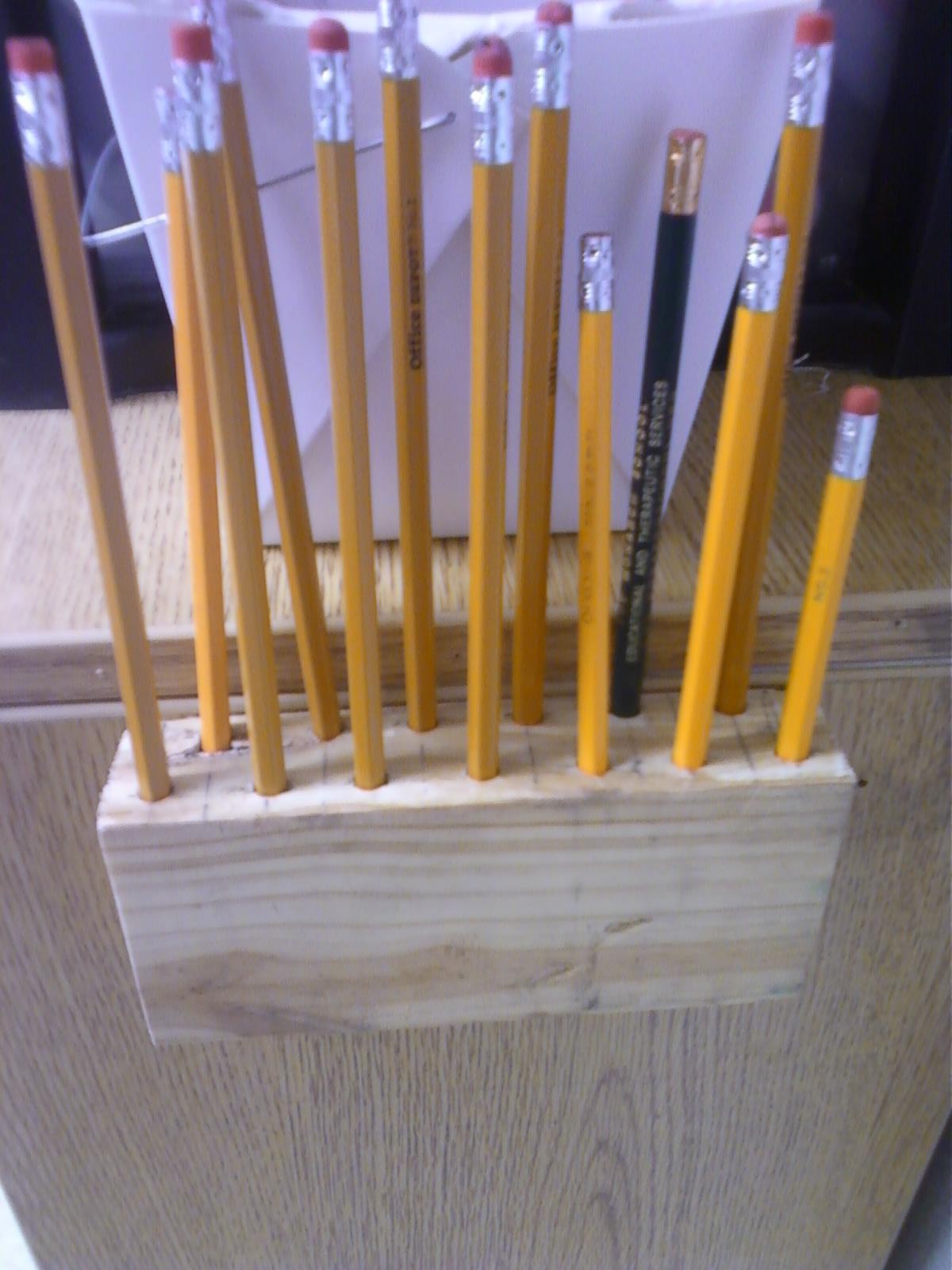 Thirteen pencils began the day, thirteen pencils ended the day. A new record!


 WSC Designs