This Week in the Shop: Fixing a Broken Jet Table Saw Fence

In the classroom, I stress safety at all times.  After a few incidents my first year as a woodworking teacher, I changed the way I teach sawing.  This year, as I’m teaching brand-new students to woodworking, I’m starting from scratch.  At home, I apply the same principle.  This blog post, though, revolves around a fact of woodworking:  it is a risky activity, even when you do everything right.

Continue reading “This Week in the Shop: Fixing a Broken Jet Table Saw Fence”

Parenting: On Making Kids Who Make Stuff

1. Determine your child’s level of interest. A child who’s fascinated by tools or electrical equipment typically demonstrates an almost obsessive interest in them, pays attention, takes direction well, and instinctively focuses on the job at hand. I’ve taught soldering to children as young as eight, and their ability to concentrate is astonishing.

If you’re a DIY enthusiast have a basement tool-and-gadget area, let your child see the fruits of working with these objects and identify with what Mom or Dad does to fix or make things. If you sense your child’s delight in imagining similar creative endeavors, then buying a kit could be a good idea.

via MAKE | 5 Safety Tips for Your Child’s First Tool and Electronic Kits.

Some interesting advice from the folks over at Make a few weeks ago on how to get a kid interested in “making” endeavors.  They have some great advice on how to create parent/child connections involving the electronics hobby.  The advice works for almost any “making” type hobby – building cars to soldering lines to writing computer code to crafting quilts or woodworking.

I am chuckling a bit to myself about the description of a kid who’s “interested” in electronics.  He’s not describing most children – he’s describing kid with an already well-developed, probably two or three year long love affair with a hobby or activity, the type of kid who turns these childhood obsessions into careers (well, look who’s blogging!  I’m willing to bet his description is as much the kids he’s taught as a autobiographical account of his childhood).

My experience tells me it’s a rare child or teen who has a true steady interest in anything.  Children burn through hobbies, interests, book genres, authors, music styles, clothing styles, hair styles, friends and academic success like wildfires through California in a drought with high winds.

Children are made to experiment with themselves – the selves they make now become the self they will be.  Your kid may like Thomas the Tank Engine for months, but when you finish the Thomas the Tank Engine bed, he’s become a nut for dragons  and monsters.  Maybe your sweet teen comes home with a sweet mohawk and some new friends with sweet sense of punk rock.  Your eight year old quits experimenting with being a victim of bullying and experiments being the bully.  Perhaps your son has always loved playing in the garage and suddenly finds a passion in the kitchen.

These changes are normal.  Nothing to sweat too much over, nothing we can do to change it.  Our job, as I see it, is to make the experiment worth something.  If a kid tries learning electronics, they learn skills – logic, perseverance, soldering and debugging – which they can take into other endeavors.  The teen sees the world as an outcast and maybe becomes more accepting of differences.  The child becomes repulsed by their actions and becomes an advocate for playground fairness and justice.  As an adult, both as a teacher, parent and maker-mentor, my job so often is to help my students find the value in their experiences, not judge the experience from my own set of semi-settled values.

So, to sum it up.  When your kid wants to give woodworking or whichever hobby you participate in, be grateful they asked.   Show them what you do.  Then don’t be surprised if she or he changes his mind.  Just be happy for the moments you steal away from the drumbeat of family for the swish of a chisel.

Make it safe & keep the rubberside down this week.

This Week In the Shop: Point and Shoot Camera Mount, V. II

Just a short slideshow this week.  Took a second shot at the camera rig.  It’s a little long, but the hardware’s been upgraded and it stays put.  I especially enjoy the mounted 1/4″ nut for the wrist joint.

This slideshow requires JavaScript.

Make it safe and keep the rubberside down this week.

This week in the Shop: Dead Simple Jig for Drilling Bottles

For the last two years, I’ve spent one weekend before Christmas drilling holes in glass blocks to create lighting stands which look like something like this:

IMG_1793

photo credit: ike4014 via photopin cc

This year, he’s asked for me to drill the same hole in a wine bottle.  In order to make this happen, I needed a jig to hold the bottle still.  In the slideshow below is the results.  Maybe you can take it to the next level.

This slideshow requires JavaScript.

Make it safe & keep the rubberside down.

This Week in the Classroom (and the shop): Time Lapse Photography or Filming Rigs

In my second period this semester, I’m moonlighting as a video producer.  I don’t get to do any fancy music videos or full-feature movies, but I do get to make a documentary.  We’ve got the backdrop ordered, the lights rigged up and a the interview stool picked out.  I even have a low-slung directors chair that I talk to when its empty.  I pretend my boss is sitting there.

This slideshow requires JavaScript.


In the woodshop, I made this little rig to support my students.  This is just a prototype.  I’ll be working on a second rig  which will find a permanent home in my woodshop when this gig is up.  I expect to be making movies which look something exactly like this.

or this…

Make it safe and keep the rubberside down this week.

Check out WoodshopCowboy @ www.toolmonger.com

I almost feel I’ve arrived!  Some kind words from www.toolmonger.com, the best tool site around.

So kudos from the TM crew, ‘Cowboy. And if you other Toolmongers have a sec, check out his blog as it’s full of other interesting thoughts, collections of fun finds, and slick projects

So make it safe & keep the rubberside down this week, will ya?

Why I Do This: Monday Nights

Why I do this is a continuing series of education..er…ahhh…editorials.  If you don’t like ’em, check out my projects!  I do a lot of woodworking here, but I do more teaching in real-life.  Teaching, whether a reader on these blogs, or at TX/RX labs, or at my work, is what I really love.  I’m a self-proclaimed I-might-be-ok-at-some-point woodworker.  I’m a wicked good teacher.  Once in a while, I’ve got to say my piece about the craft of teaching.

Just helped put my children to bed. Nothing special, really. Probably the same thing your doing, probably the same thing any number of parents do. Nothing really special there. Maybe your catching the premier of that show with a monkey. Or a mob doctor. Hell, it’s Monday, so maybe your catching the game. Nothin’ special there either.

But, it is Monday, so I’m putting grades together, planning lessons and building curriculum. I’ve got a stack of e-mails to catch up on. Including a few from my students asking for help. I’ll answer those first, my boss, god love him, can wait. See, I’m a teacher so when my duties with my own kids are completed, I go back to work for yours.

And there’s nothing special there either. Your kid’s teachers are doing the same, because that’s what your kid, and listen up, here’s the important part, and every other kid deserve.

And I really ain’t asking for much. I ain’t asking for a lot of money. I ain’t worried about the hours, because I already volunteer to teach summer school. I already run after-school clubs, after-school tutoring and stay after-school to plan.  Early in my career, I took a $10k pay cut in order to teach after-school and get my Master’s at the same time.  I sacrifice because I love the work and I love the purpose.

But I would like, just once, to see my profession described in the media as engaging and rewarding, challenging and necessary instead of lazy and incompetent. I’d like to see, just once, when someone asks, “Why do they strike?” for someone other than me say “Because it’s an American worker’s right” instead of “greed”. And I’d like it, when I introduce myself to my wife’s colleagues, all the bright-suited and cubicled bunch of ’em, for them to give me the same respect I give them: I don’t tell you how to run a business, so don’t tell me how I should “educate” kids. You make the widgets, bud.

I make men and women and the sunshine in your day when they come home laughing saying “Daddy, Mommy, guess what I LEARNED today!!!”
That’s what I make.  That’s what I do.  It’s why I do this.
Make it safe, keep the rubber-side down this week.

Tool Primer: How to Select and Use Power Drills

The first power tool I probably ever used (and owned) was a power drill.  The lowly power drill can do a whole lot of things if you know how to use it.  A power drill can strip paint, drill big holes, little holes, create dowel joints, sand curves and screw stuff together.  It makes pocket holes and wood split.  If you don’t know exactly what a power drill is, it is a handheld tool which spins a metal bit attached to an electric motor via a chuck.  The magic of the drill is in the bit.

In short, it’s pretty essential to the hobbyist and homeowner.  In this post, I’ll break down the types of (power) drills available for the average homeowner/hobbyist/woodshop teacher and give some tips on how to choose which is right for you.

First, let’s take a walk through history, why don’t we? Continue reading “Tool Primer: How to Select and Use Power Drills”

This Week in the Shop: Merchandise Display

It’s taken me a few years, but I’ve begun accepting commissions.  A friend of mine came with a project I couldn’t refuse.  He wanted a chest to haul around the merchandise related to his rock band.  He said he wanted something that light up the event and highlighted the band’s name.  I knew just what he wanted!

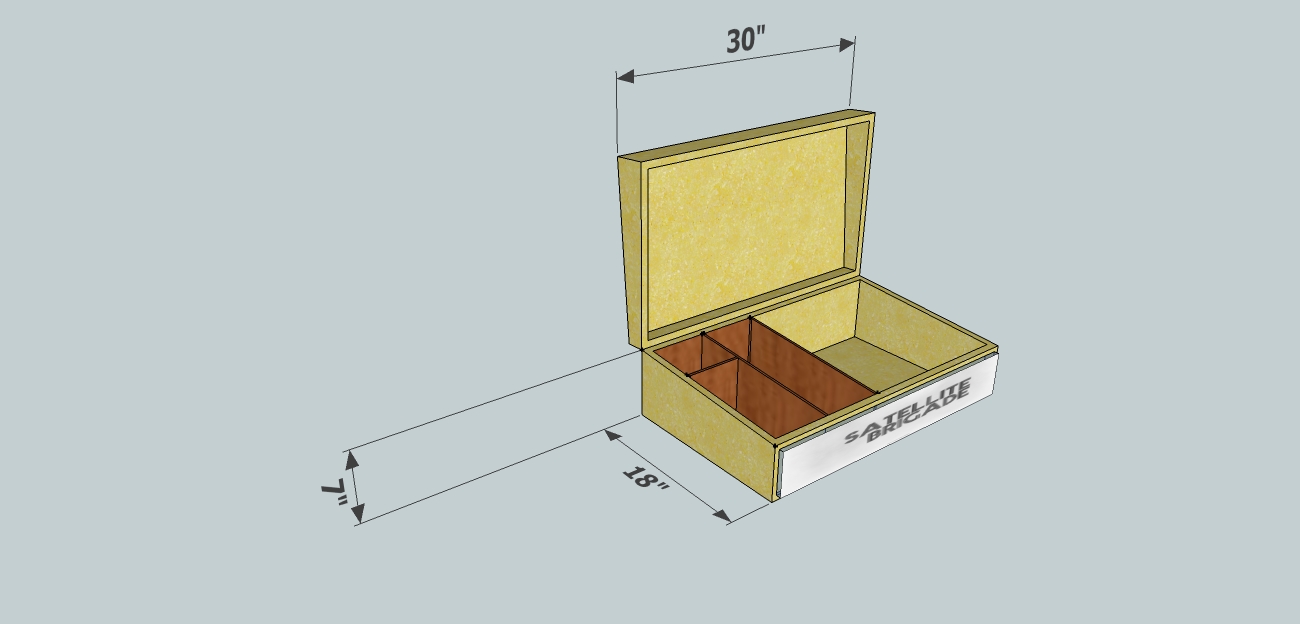
I started with this SketchUp draft:

It has room for CDs, t-shirts, bumper stickers and t-shirts.  My final design veered a little from this, but the basic shape was there.

I began with a 30″ long, 18″ deep, 7″ high box.  I chose box joints as the joinery.  I recently acquired a table saw (Jet Supersaw with sliding table) which made the production of those joints easy.  I shot a dado down both top and bottom to fit the 1/4″ plywood top and bottom panels.  I dry-fitted the box, dissembled it, then ripped the top and bottom apart on the table saw.

This slideshow requires JavaScript.

Next up came fitting the nameplate.  This took a little finessing.  I decided on a 2″ by 20″ removable nameplate fitted into a frame and panel type groove with a piece of acrylic as protection.  I ripped the front face apart into four sections: a 1″ wide top rail, about a 1.5″ bottom rail and two stiles.  After reassembling the piece to check the joinery, I needed to make a dado groove for the faceplate and acrylic.  The groove necessary was just a hair (and I mean a hair) over an 1/8″ of an inch wide.  So I went to my router table (oh, I should mention – this step meant I had to build a tablesaw/router table combo machine first.  Nothin’ like buying and building 1000 dollar tools for a 100 dollar project) and shot a stopped dado down the rails and stiles.  In order to get the faceplate to fit, I made a starter groove just a hair off center, then reversed the parts to get a centered groove.  (If that doesn’t make sense to you, watch an episode of Norm) Finally, I glued up the bottom half of the front face and attached the top rail via #8 Phillips-head wood screws.  If the band name changes, so does the display.

The interior partitions came together next.  The front compartment, which holds the lighting assembly, is simply a horizontal cross piece with a plywood top attached via three small hinges.  I ripped matching dadoes across the cross bar and rear face of the box.  1/4″ plywood creates the CD racks.  A piano hinge flips the top, while a hobby chain keeps the top constrained.  Last but not least, a pair of latches keeps everything tied down for transport.

I went with a simple black acrylic base and polycrylic topcoat.  Sprayed it on with a Critter spraygun.  Hope you enjoy the results.

If you have a rockband I’ve got a little something for you…call me, maybe?

Expect some new “In the Classroom” posts: the boys are back in town!

Make it safe & keep the rubberside down this weekend.  Like WoodshopCowboy on Facebook and get yerself in the drawing for a little something.

Popular Woodworking Editors Blog: Your Guide to Butt Hinges

Stamped vs. Extruded vs. Cast hinges

• Inexpensive hinges are usually stamped out of thin steel or brass plates.

• Extruded hinges are molten metal forced into a die under high pressure. They are thicker, sturdier and more expensive.

• Cast bronze hinges are among the most expensive — bronze is melted and poured into a mold, resulting in a perfectly smooth surface and perfectly aligned pins.

via Your Guide to Butt Hinges.


Some great information on type, countersinks and placement of butt hinges.  Check it out.


Make it safe & Keep the Rubberside down this week!